Back to event

Event session · Dallas Business Accelerator

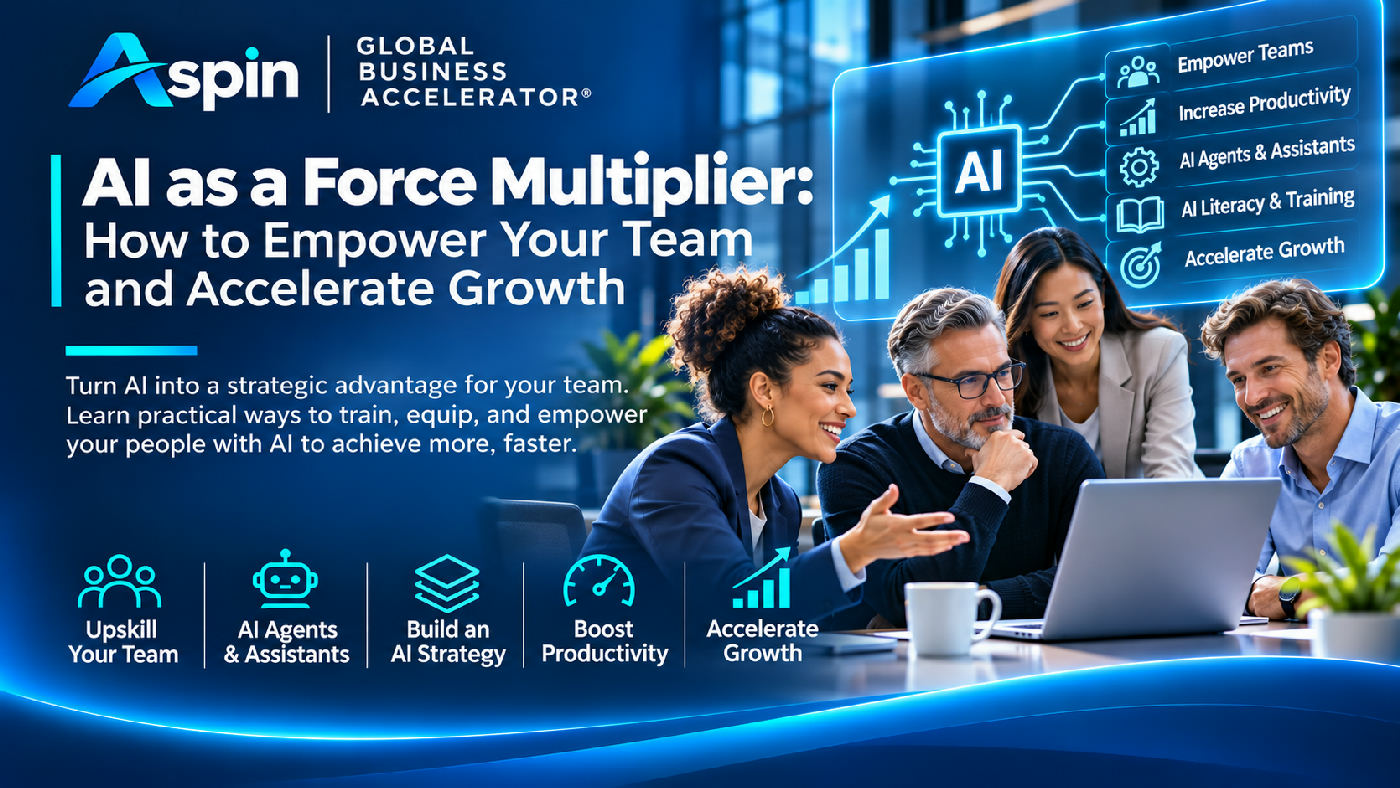
AI as a Force Multiplier: How to Empower Your Team and Accelerate Growth

AI as a Force Multiplier: How to Empower Your Team and Accelerate Growth

What if your existing team could accomplish significantly more without adding employees or increasing overhead? Join CEOs, AI strategists, technology executives, and business leaders to discover how artificial intelligence can become a force multiplier for your organization. Explore AI literacy, employee training, intelligent assistants, AI agents, and practical strategies for helping teams work smarter, make better decisions, and accomplish more. Learn how to develop an AI strategy that empowers employees, increases productivity, and accelerates business growth in 2027.

Tue, Nov 17
8:30 AM – 9:00 AM MST
Live online

About this session

Artificial intelligence is creating new opportunities for businesses to accomplish more with the people and resources they already have.

Rather than simply replacing manual tasks or reducing headcount, AI can become a powerful force multiplier—helping employees expand their capabilities, make better decisions, solve problems faster, and deliver greater value to customers.

Imagine a sales professional who can research prospects, prepare personalized proposals, and manage more customer relationships. A marketing team that can develop campaigns, analyze results, and produce content more efficiently. Or an operations manager who can identify bottlenecks, improve workflows, and make decisions using better information.

What happens when every employee has access to tools that amplify their expertise and productivity?

Join experienced CEOs, AI strategists, technology executives, and business transformation leaders for a practical discussion on how organizations can use AI to empower their teams and accelerate growth.

Our panelists will share firsthand experiences introducing AI into organizations, educating employees, developing AI strategies, and helping teams adopt new technologies successfully.

Discover why AI literacy is becoming an important business skill and how companies can prepare employees to understand AI capabilities, recognize its limitations, and apply it effectively in their daily work.

We'll explore the differences between AI assistants, AI agents, generative AI, and traditional automation—and how each can help employees become more productive.

Learn how executives can identify opportunities where AI complements human expertise, supports decision-making, improves communication, and reduces time spent on repetitive tasks.

The discussion will also address how to create an organizational AI strategy, establish responsible usage policies, protect sensitive business information, and build employee confidence in adopting new tools.

We'll examine how AI can strengthen collaboration between departments, improve access to company knowledge, and enable smaller teams to compete more effectively with larger organizations.

Beyond technology implementation, our panelists will discuss the leadership changes required to build an AI-enabled workforce, including employee training, organizational culture, performance measurement, and continuous learning.

Whether you're a CEO developing an AI strategy, a business owner looking to increase team productivity, or an executive preparing employees for the future of work, this session will provide actionable insights to help your organization accomplish more with AI in 2027.

Following the panel, participate in a 10-minute networking session to connect with AI executives, business leaders, technology innovators, and professionals focused on developing more capable, productive teams.

What you'll take away

  • Understand AI as a Force Multiplier: Learn how AI can expand employee capabilities, improve productivity, and help teams accomplish more with existing resources.
  • Build AI Literacy Across Your Team: Discover how to educate employees about AI fundamentals, practical applications, limitations, and responsible use.
  • Develop a Practical AI Strategy: Learn how to align AI initiatives with business goals, workforce needs, and organizational priorities.
  • Empower Employees With AI Assistants: Explore how AI can help employees research information, prepare documents, analyze data, communicate effectively, and complete tasks faster.
  • Understand AI Agents: Learn how AI agents differ from traditional assistants and how they can coordinate business activities with appropriate human oversight.
  • Identify High-Impact Opportunities: Discover how to evaluate employee workflows and determine where AI can deliver meaningful productivity improvements.
  • Improve Decision-Making: Explore how AI can help executives and employees analyze information, evaluate alternatives, and make better-informed decisions.
  • Increase Team Productivity: Learn how employees can reduce repetitive work, improve output quality, and focus on higher-value responsibilities.
  • Strengthen Sales & Marketing Teams: Discover how AI can help employees research customers, develop campaigns, prepare presentations, and manage relationships more effectively.
  • Improve Collaboration & Knowledge Sharing: Explore how AI can make organizational information more accessible and help teams work more effectively across departments.
  • Prepare Employees for AI Adoption: Understand how to build confidence, address resistance, develop skills, and encourage responsible experimentation.
  • Establish AI Governance: Learn how to create policies for data protection, security, accuracy, accountability, and human oversight.
  • Measure AI Productivity Gains: Discover how to evaluate time savings, employee effectiveness, output quality, and business outcomes.
  • Build a Competitive Advantage: Explore how an AI-literate workforce can help smaller organizations compete and innovate more effectively.
  • Create a 90-Day AI Adoption Roadmap: Learn how to prioritize employee training, select initial use cases, launch pilot projects, and measure results.

Who should attend

  • CEOs, presidents, and company founders
  • Small and midsize business owners
  • Chief operating officers and operations executives
  • Chief technology officers and technology leaders
  • Chief information officers and IT directors
  • Chief AI officers and AI strategy executives
  • Human resources and workforce development executives
  • Sales and marketing leaders
  • Department managers and team leaders
  • Professional service company owners
  • Consulting firm founders and managing partners
  • Fractional executives and business advisors
  • Organizational development and leadership consultants
  • AI implementation and automation specialists
  • Business transformation and innovation executives
  • Technology and SaaS company founders
  • Executives preparing their organizations for AI adoption

Questions

  • What does it mean to use AI as a force multiplier for employees and teams?
  • How can businesses increase employee productivity with AI without significantly increasing headcount?
  • What is AI literacy, and why should every organization invest in it?
  • What should CEOs and executives understand about AI before introducing it across their companies?
  • How can businesses develop an AI strategy that supports their people and business objectives?
  • What are the differences between AI assistants, AI agents, generative AI, and traditional automation?
  • Which employee responsibilities and workflows benefit most from AI assistance?
  • How can sales professionals use AI to manage more customer relationships and pursue more opportunities?
  • How can marketing teams use AI to increase their output without sacrificing quality?
  • How can AI help managers analyze information, communicate with employees, and make better decisions?
  • What AI skills should employees develop to remain effective in an evolving workplace?
  • How can companies train employees to use AI successfully?
  • How should business leaders address employee concerns about AI replacing jobs?
  • How can companies encourage AI adoption without creating confusion or overwhelming employees?
  • What policies should organizations establish for responsible AI use?
  • How can businesses protect confidential information and customer data when employees use AI?
  • How can executives determine which AI tools or platforms are appropriate for their organizations?
  • Should companies give employees individual AI tools or develop a more integrated organizational AI system?
  • How can AI improve collaboration, information sharing, and coordination between teams?
  • What are the biggest mistakes companies make when introducing AI to employees?
  • How should businesses measure productivity improvements and the return on investment from AI?
  • What should an executive's first 90 days of implementing an AI workforce strategy look like?
  • How can smaller companies use AI to compete against larger organizations?
  • What should CEOs prioritize in 2027 to build an AI-enabled workforce?

Meet your speakers

Caroline Hinton

Caroline Hinton

Founder & Principal, AI Strategy and Enablement · Growth Partner Pro

Caroline Hinton is a Fractional AI Executive with over 20 years of experience in AI strategy, governance, and enablement. She specializes in designing practical AI strategies and integrating AI into operations to accelerate growth and improve efficiency.

View speaker profile
Adriano Patrão

Adriano Patrão

CEO & Founder · Lucent Minds

Adriano Patrão is an accomplished technology entrepreneur and AI strategist with over 25 years of experience building, scaling, and leading technology businesses. He specializes in enterprise AI implementation, M&A, and business growth.

View speaker profile
Mike Clesceri

Mike Clesceri

Founder & CEO · The Alpine Agile Standard

Mike Clesceri, Founder of Alpine Agile, is an executive advisor and strategist specializing in enterprise delivery and digital transformation. He helps organizations improve performance, eliminate bottlenecks, and maximize technology investments.

View speaker profile
Brian Kerrigan

Brian Kerrigan

Founder & Managing Partner · Excelerating AI; Excelerating Business Growth

Brian Kerrigan is an attorney, tax strategist, and M&A advisor with over 30 years of experience. He specializes in AI-powered tax strategies and business value creation for accounting firms and privately held businesses.

View speaker profile
Tami Crea

Tami Crea

Founder/Owner · Authority Echo

Moderator

Tami Crea is a marketing and business automation expert with 40+ years of experience. She specializes in AI-powered business systems to streamline operations, optimize revenue, and automate tasks.

View speaker profile
Johnny Gabriele

Johnny Gabriele

CEO · Daedalus

Johnny Gabriele is an accomplished technology entrepreneur and AI innovation strategist. As Founder and CEO of Daedalus, he specializes in custom software and AI-powered business systems for growth and efficiency.

View speaker profile
Steven Tedjamulia

Steven Tedjamulia

Founder and Executive Director · Aspin Business Accelerator

Steven Tedjamulia is an entrepreneur, product leader, and applied AI innovator with more than 25 years of experience helping organizations turn emerging technologies into measurable business results.

View speaker profile
Elijah Jones

Elijah Jones

Founder & AI Chief · AI Native Banking Lab

Elijah Jones is an award-winning enterprise AI product executive and financial technology innovator. He founded AI Native Banking Lab and created VerifyIQ™, specializing in AI strategy for financial institutions.

View speaker profile